Why most contractor marketing looks the same (and the three things that break the pattern)

- Trades marketing converges because contractors copy competitors, lean on stock photos, and fall back on templates when time is short
- When every contractor looks identical, homeowners default to comparing price
- Three changes break the pattern: real job-site photos, owner voice in captions, and process content instead of only finished work
- Consistency over months matters more than volume in any single week
Open Instagram and search your trade in your city. Scroll for two minutes.
You'll see the same post over and over. A before-and-after with an arrow between the frames. A stock photo of a handshake with a caption about quality and trust. A truck parked at an angle in an empty lot. A "we're hiring" graphic in whatever colours the free template came in.
Now here's the uncomfortable part: some of those posts are probably yours.
This isn't a talent problem. Most contractors doing this run excellent businesses with full schedules and real referrals. The marketing just doesn't look like the business. It looks like everyone else's marketing, which means it might as well not exist.
Why it happens
Three forces push every trades business toward the same feed.
Everyone copies the same three competitors. When a roofer decides to get serious about social media, the first move is checking what other roofers post. Those roofers did the same thing two years earlier. The result is a photocopy of a photocopy, and each generation loses a little more of whatever made the original work. Nobody in the chain is lazy. They're just all looking sideways instead of at their own job sites.
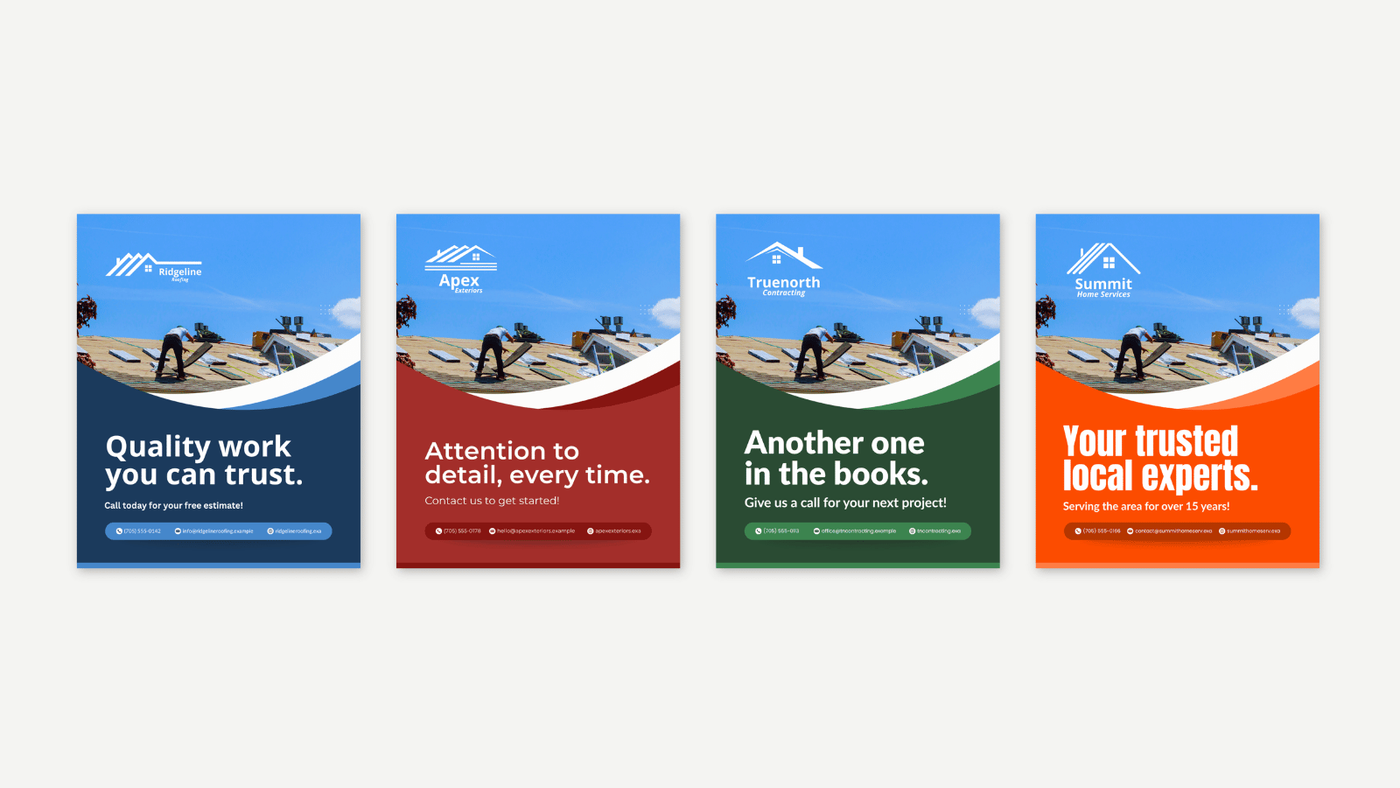
Stock photography fills the gaps. Real photos take effort, so the stock handshake shows up on week three. But stock photos are the fastest way to look like a franchise. Your customers have seen that exact smiling crew on a plumber's site in Texas and an HVAC company in Manchester. Their brain files it under "generic" before reading a word.
There's no time, so templates win. You're quoting jobs at 7 pm. A pre-made template that says "5 Signs You Need a New Roof" is right there. The problem isn't that templates are bad. It's that four hundred other roofing companies used the same one this month.
None of this is a moral failing. It's what happens when marketing is the eleventh priority on a ten-item list. But the sameness has a real cost: when every contractor looks identical, homeowners pick on price. The moment your marketing is interchangeable, you've volunteered to compete as a commodity.
The three things that break the pattern
The good news is that standing out in the trades takes surprisingly little, because the bar is on the floor. You don't need to be clever. You need to be specific.
1. Real job-site photos with your actual crew
Not staged. Not polished. A photo of your foreman reading plans on a tailgate beats any stock image ever taken, because it's evidence. Homeowners hiring a contractor are trying to answer one question: who is actually showing up at my house? Stock photos dodge the question. Real photos answer it.

2. Owner voice instead of brand voice
Most contractor captions are written by no one. "We pride ourselves on quality craftsmanship and customer satisfaction." No human says this sentence out loud. It's the written equivalent of hold music.
Compare that to: "Third heat pump this week where the last installer skipped the pad. Here's what that costs you in five years." One of these gets read. The second one also does something the first can't: it proves you know things. Expertise on display is the strongest trust signal in the trades, and it can't be faked with adjectives.
Write captions the way you'd explain the job to the homeowner standing next to you. If a sentence wouldn't survive being said out loud on a job site, cut it.
3. Show the process, not just the after
Every contractor posts the finished deck. Almost nobody posts the footing inspection, the day the framing went sideways because the lumber order was wrong, or the fix.
Process content works for a reason that's easy to miss: the finished photo proves the job got done, but the process proves how you work. Homeowners aren't just buying an outcome. They're buying six weeks of strangers at their house, and process content is the only marketing that answers what those weeks will be like. It also happens to be the content nobody can copy from you, because it's literally your job as it happens.
How often should you actually post?
A realistic baseline for a busy trades business, no agency required:
Two real job-site photos with captions in your own voice. One process post, even if it's just "here's why we do it this way" over a phone photo. One post that teaches something a homeowner wouldn't know. That's four posts, maybe ninety minutes total including the photo-taking, and it will out-perform a daily template schedule inside two months.
One last honest note: none of this works as a burst. A great month followed by silence reads worse than a plain feed that never misses. Consistency is boring advice, but in a market where most competitors quit posting by February, showing up is itself a differentiator.
The pattern is easy to break because so few are trying. Same photos, same captions, same templates, all around you. Three changes, and your feed stops looking like everyone's and starts looking like evidence.