Your Google listing is doing more work than your website

- Google replaced the public Q&A section on business listings with Gemini-generated answers, which reached Canadian users in August 2026
- The March 2026 core update shifted weight toward profile completeness, review recency, and owner response rate
- Primary category remains the single highest-impact field on the profile
- Google banned review kiosks, review gating, staff quotas, and asking customers to name employees in April 2026
Someone looking for a business like yours types "plumber near me" or "physio Sudbury." Three listings appear at the top with photos, ratings, hours, and a call button. They read a few reviews, glance at the photos, and tap call.
They never open anyone's website.
That pattern isn't new. What's new is how much changed underneath it during 2026, and how little of it got announced. If your listing has been sitting untouched since you claimed it, the ground moved and nobody told you.
What changed, and when
Four things, in the order they'll affect you.
The Q&A section stopped being yours. Google shut down the Q&A API in November 2025 and started pulling the public Q&A section from listings that December. In its place is Ask Maps, a Gemini-powered feature that generates answers to customer questions in real time, pulling from your listing, your reviews, and your website.
Worth being precise here, because most coverage overstates it: you can still see and answer existing questions on the back end of your profile, and those answers still feed Google's understanding. What you've lost is the ability to seed and control the public answers customers see. Google answers now, using whatever it can find.
Ask Maps reached Canada on August 6, 2026. It launched in the US and India back in March. Canadian users only got it a few weeks ago, which means most Canadian businesses haven't seen it yet and almost nothing written for this market accounts for it.
Practically: an AI is now writing descriptions of your business for Canadian customers, assembled from your profile, your reviews, and your site. If those sources are thin, it either answers vaguely or says there isn't enough information, and the customer moves to a competitor whose listing was better fed.
Activity started outweighing history. The March 2026 core update tightened the connection between profile completeness and local pack visibility. Businesses missing hours, services, photos, or attributes lost ground. At the same time, review recency and owner response rate started outweighing raw review count. A business with two hundred old reviews can now sit below a competitor with forty recent ones and an owner who replies.
The blunt version: a listing you set up once and never touched isn't neutral. It's fading.
Review rules got much stricter, and the enforcement is automated. In April 2026 Google made two changes in as many days. Staff review quotas and asking customers to mention an employee by name became explicit violations. Review kiosks, shared tablets, and in-store review stations are now against policy, as is review gating, meaning pre-screening customers by sentiment before sending the review link. Incentivising reviews with discounts, gifts, or loyalty points is prohibited, including offering something to get a negative review revised.
If your current process involves any of those, it was probably standard advice two years ago and is now a liability.
What actually moves the needle
Most guidance on this is a checklist of forty items. Four carry real weight.
Your primary category
This is the highest-leverage field on the profile and most businesses pick something too broad and never revisit it. A law firm listed under "Law firm" competes with every lawyer in the region. The same firm under "Personal injury attorney" surfaces for the searches it can actually win.
Choose the narrowest category that's genuinely accurate, then add secondary categories for the rest. Check again in six months, since Google adds categories regularly and a better fit may now exist.
Photos and a profile that's actually filled in
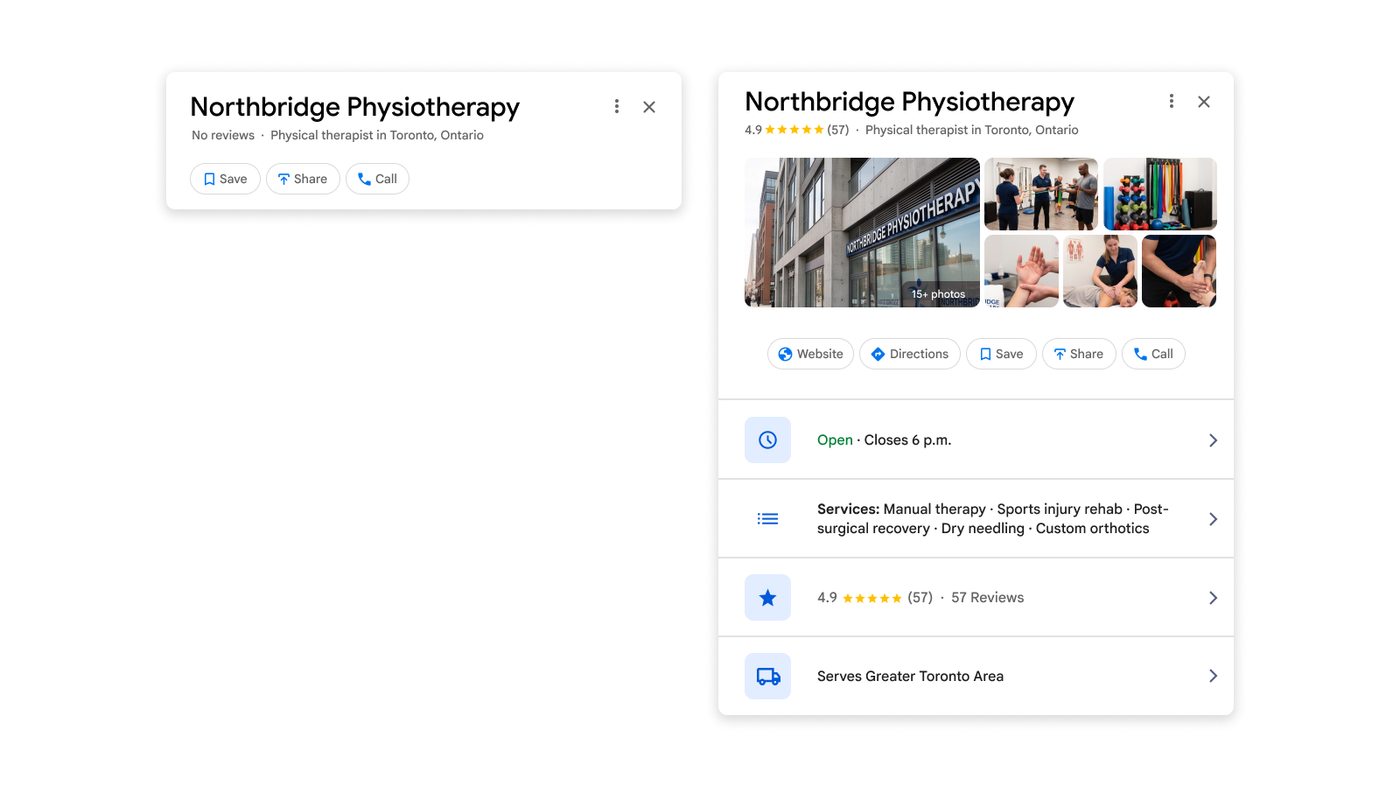
Not your logo. Photos of the work, the space, the people. Beyond feeding freshness signals, photos are what a customer looks at before deciding.
The bar is lower than you'd think. A steady trickle of real phone photos beats a professional shoot from four years ago, because recency is the thing being weighed.
Same for the boring fields. List your services individually with real descriptions instead of leaving the section empty. Update hours for holidays. If you're a service-area business, list your regions specifically rather than drawing one enormous circle. Google cross-references your profile against your website, so contradictions between the two make you look less reliable to the system, and to Ask Maps when it's assembling an answer about you.
Reviews you actually respond to
Response rate is a signal now, and it costs nothing. Every review, good or bad, gets a reply. Not a template. Two sentences that sound like a person.
Negative reviews deserve more attention than they get. A measured, non-defensive reply does more for the stranger reading it than the review itself does against you. What sinks businesses is silence, or arguing.
On asking for reviews: a neutral request after the job is done is still fine, by email, text, or just asking. What's out is anything that pressures, filters, or pays for the outcome.
Not making three big edits on a Tuesday
Suspensions climbed through 2026 and caught a lot of legitimate businesses. The common triggers are worth knowing: a keyword-stuffed business name (your listing name should match your actual registered name, not "Best Plumber Sudbury 24/7"), a mismatch between your address or category and your other records, and a burst of rapid edits to core fields.
That last one surprises people. If you're updating your name, category, and address, space the changes out rather than doing them all in one sitting.
How much time does this actually take?
Twenty minutes a week keeps a listing healthy.
Two or three photos from whatever you worked on. Replies to any new reviews. A quick check that your hours are right. Once a quarter, a longer pass: revisit your category, refresh your services, confirm your name and phone number match everywhere else you're listed.
That's it. There's no version of this requiring an agency, and anyone selling a monthly retainer purely for listing management is selling you twenty minutes.
It's worth those twenty minutes because of the asymmetry. Your website costs money to build and maintain, and a large share of the people looking for you never reach it. The listing is free, it's where the decision actually happens, and the current system rewards exactly the kind of small consistent attention most of your competitors won't bother with.
Same conclusion as most things in marketing. Showing up regularly beats doing something impressive once.